AI Writing Tools for UK Job Applications: Where They Fit
Where AI writing tools genuinely help a UK job application, where they quietly damage it, and the one rule that matters when sponsorship is involved.
Quick answer
AI writing tools are useful for structure, tightening, and UK-idiom editing, and unreliable for anything factual. Use them to reorganise material you have written, to convert an international CV into UK conventions, and to check whether a draft actually answers an advert. Do not use them to invent achievements, to state anything about your right to work, or to explain immigration rules — a model's training data has a cut-off, the rules move, and UK employers are legally required to check the facts anyway. Declare AI use whenever an employer asks, and never paste confidential material into a tool.
Key takeaways
- AI helps most with form and least with facts.
- Anything about your right to work must be accurate: employers must run a
documented check before employment starts.
- Model output is confident regardless of whether it is correct. Confidence is
not evidence.
- Immigration and salary rules change. Verify every figure against GOV.UK rather
than against a chat window.
- Homogenised prose is a real cost. Recruiters read hundreds of applications and
notice the pattern.
- Declare AI use when asked, and follow any stated employer policy.
- A sponsor licence is permission to sponsor, not a promise to sponsor any role
or any person, and no writing tool changes that.
Disclosure
This site is published by the team behind a UK sponsor-search tool, which is a browser extension. That gives us a commercial interest in the job-search tools category. Read this page with that interest in mind: nothing here is a recommendation to buy any particular product, and every rule cited comes from GOV.UK or legislation you can read yourself.
What these tools are actually doing
A large language model predicts plausible text. Given your draft and an advert, it produces writing that looks like writing that usually follows. That is a genuinely useful capability for form — ordering, compression, tone, consistency — and a poor one for truth, because plausibility and accuracy are different properties.
Everything below follows from that distinction. The tasks where these tools are strong are the ones where a plausible answer is a good answer. The tasks where they are weak are the ones where only a correct answer will do.
Where they help
Turning a wall of text into a structure
If you have written four paragraphs about a project, a model will reliably restructure it into a situation-task-action-result shape, or into three bullets with the outcome first. You supply the content; it supplies the arrangement.
Converting an international CV to UK conventions
This is a genuinely good use. UK conventions are specific — two pages, no photograph, no date of birth, UK spelling, month-and-year dates — and a model applies them consistently across a document faster than you will by hand.
Give it the conventions explicitly rather than asking for "a UK CV", and check the output line by line.
Coverage checking against an advert
Paste the advert's requirements and your draft, and ask which requirements the draft does not address. This is a comparison task, and models do it well. It frequently surfaces a requirement you skimmed past.
Tightening
Ask for a version 30% shorter with no new claims. Then read it and put back anything specific that was cut — models tend to cut the numbers, which are the part worth keeping.
Interview preparation
Generating likely questions from a job description is a reasonable use. So is being asked follow-up questions about your own answers, which surfaces the answers you cannot yet give. Rehearse the substance rather than a script — a memorised paragraph is obvious in a room, and it collapses the moment an interviewer asks something adjacent.
Where they hurt
Fabrication
Models invent specifics — a certification you do not hold, a metric you never measured, a project outcome that sounds right. If you do not check every claim in the output, you are submitting statements you have not verified about yourself. That surfaces at interview or reference stage, where it is far more damaging than a weaker draft would have been.
The sameness problem
Recruiters read a great many applications. Unedited model output has a recognisable rhythm: tricolons, "passionate about", "leveraging", em-dash-heavy sentences, and an opening line that restates the job title back at the reader. The cost is not that a reader thinks "this is AI". It is that nothing in the letter distinguishes it from the four before it.
Losing the specifics that carry weight
The parts of an application that persuade are concrete: team sizes, tools, constraints, numbers, what went wrong and what you did. Compression tends to remove exactly those, because they are the least predictable text in the document.
Wrong conventions, confidently applied
Ask for "a resume" and you may get US conventions. Ask for "a cover letter" and you may get an address block that no UK employer uses. The tool has no way to know which market you are in unless you say so.
Factual claims about immigration
This is the one that matters. A model will happily state a salary threshold, a processing time, or an eligibility rule. It may be quoting something accurate; it may be quoting something that changed. The skill threshold moved to RQF level 6 on 22 July 2025, in a change the Home Office described as "a reduction of around 180 eligible occupations" Source: GOV.UK — Explanatory memorandum to HC 997, 1 July 2025. Plenty of text written before that date is still circulating, and a model trained on it will reproduce it fluently.
Check every figure against GOV.UK. The current standard salary threshold is £41,700 a year or the going rate for the occupation, whichever is higher, with lower floors from £33,400 for defined groups Source: GOV.UK — Skilled Worker visa: your job, verified against GOV.UK on 6 August 2026.
The rule that is not negotiable
Never let a tool write a statement about your right to work that is not exactly true.
UK employers must carry out a right to work check before employment begins, using an online share code, a manual document check, or an identity service provider using identity document validation technology, and must keep records during employment and for two years after it ends Source: GOV.UK — Check a job applicant's right to work. The consequences for an employer that gets it wrong are serious: a civil penalty of up to £60,000 per illegal worker, and, where the employer knew or had "reasonable cause to believe", up to five years in prison and an unlimited fine Source: GOV.UK — Penalties for employing illegal workers.
That is why the check happens without exception, and why an inaccurate statement in an application is not a small problem. The same page tells employers: "You must not discriminate against anyone because of where they're from." Stating your position accurately is the safe move in both directions.
If you want a sentence about your status, write it yourself in plain words. One line is enough.
Employer policies and declarations
Employers increasingly state a position on AI use in applications. Three patterns are common:
| Employer stance | What it usually means |
|---|---|
| No stated policy | Use as an editing aid; the work must be yours |
| "You may use AI, please declare it" | Declare it, briefly and factually |
| "Do not use AI for this exercise" | Do not use it, including for editing |
The third case matters most for assessed tasks — take-home exercises, written assessments, timed cases. Ignoring an explicit instruction there is an integrity issue, not a stylistic one, and it is the kind of thing that ends a process.
When a form asks whether you used AI, answer it accurately. "I used an AI tool to edit and shorten my own draft" is a complete answer and costs nothing.
Data you should never paste in
- Anything covered by an NDA or a confidentiality clause from a current or
former employer.
- Client names, unreleased product details, internal metrics.
- Other people's personal data — referees' contact details, colleagues' names in
a performance context.
- Full identity documents. There is no application task that requires pasting a
passport into a chat window.
Check whether the tool you use trains on your inputs, and whether it retains them. Consumer tiers and business tiers of the same product often differ on exactly this point, and the answer is in the product's documentation rather than in its marketing.
A workflow that keeps the value and drops the risk
- Write the raw material yourself. Bullets, fragments, numbers. Ugly is
fine.
- Give the tool the advert and your raw material, and ask it to identify
which requirements you have not addressed.
- Fill those gaps yourself, in your own words.
- Ask for structure, not content: reorder, compress, apply UK conventions.
- Read every line and reinstate the specifics the compression removed.
- Verify every factual claim — figures, dates, rules — against GOV.UK or
the employer's own materials.
- Read it aloud. Anything you would not say in a room, cut.
Steps one and five are what separate a useful draft from a generic one. They are also the two steps people skip.
What AI cannot tell you at all
Whether an employer holds a sponsor licence
This is a lookup against a published file, not a question of language. The Register of Licensed Sponsors: Workers lists organisations permitted to sponsor, with their town, county, licence rating and routes Source: GOV.UK — Register of licensed sponsors: workers. Our copy of the file, published as of 11 August 2026, holds 127,672 organisations, and it changes almost daily. A model asked "does X sponsor?" cannot read today's file, and an answer that sounds specific is a warning sign rather than a result. Our guide to checking a sponsor licence free covers the actual method.
What the current rules are
Rules with expiry dates are especially dangerous to ask a model about. The Temporary Shortage List and expanded Immigration Salary List run to 31 December 2026 Source: GOV.UK — Temporary Shortage List: Stage 1 report, verified against GOV.UK on 6 August 2026. Any answer about them is only as good as its date.
Anything case-specific about your immigration position
The Immigration Advice Authority regulates who may act here, alongside the bodies that regulate solicitors and barristers. The statute is blunt: "No person may provide immigration advice or immigration services unless he is a qualified person" Source: legislation.gov.uk — Immigration and Asylum Act 1999, s.84. A chatbot is not a qualified person, and neither is this page. For your own circumstances, GOV.UK's adviser finder is the route, with the standing warning that you cannot get your money back if an adviser is not regulated Source: GOV.UK — Find an immigration adviser.
Prompts that produce something usable
The difference between a generic draft and a useful one is almost entirely in what you give the tool. Three patterns work:
Constrain the output, not the topic. "Rewrite these bullets in UK English, active voice, no adjectives, keep every number" produces an edit. "Write me a cover letter for this job" produces a template.
Ask for gaps, not for prose. "Here is the advert and here is my draft. List the requirements my draft does not address, and nothing else." The answer is a checklist you can act on, and there is no text to be tempted into pasting.
Ask it to argue against you. "What would a sceptical interviewer ask about this claim?" Weak claims surface immediately, and the fix is usually a specific you left out.
Two patterns that reliably waste time:
- Asking for facts about immigration rules, salaries, or specific employers.
Those are lookups, and the sources are free.
- Asking for a full document from a job advert alone. The output can only be
about the advert, because the advert is all it has.
Judging an AI application tool
The same four questions apply here as to any tool in this category:
- What does it do? Editing, generation, or evaluation? A tool that scores
your CV against a job description is doing something checkable. A tool promising interview success is not.
- What does it cost? Including renewal and the cancellation route.
- What data does it see? Does your document leave your machine? Is it used
for training? Our guide to browser permissions covers how to read the equivalent question for extensions.
- What are its limits? A vendor that states them plainly is easier to
trust.
Free general-purpose assistants do most of what paid application-specific tools do. Before paying, work out which step you are actually buying.
The bottom line
Use AI writing tools for what they are good at: arrangement, compression, convention, and coverage checking against an advert. Supply the substance yourself, put the specifics back after every edit, and verify every fact against GOV.UK before it goes anywhere near an application.
Above all, keep the right-to-work sentence in your own words and exactly true. Employers must check it, and the rest of your application depends on being believed. As for the employer question itself, that is a register lookup — and even there, a licence is permission to sponsor, not a promise to sponsor any role or any person.
This page is information, not immigration advice. This site is not affiliated with the Home Office or GOV.UK. For your own circumstances, check GOV.UK or speak to an adviser registered with the Immigration Advice Authority or a regulated solicitor.
Frequently asked questions
Is it allowed to use AI for a UK job application?
There is no general prohibition, and many employers now state a policy. Follow whatever the employer says, declare use when asked, and never use it for an assessment that explicitly forbids it.
Will an employer be able to tell?
Detection claims are unreliable in both directions. The practical risk is not detection; it is that unedited output reads like every other unedited output and says nothing specific about you.
Can AI write my cover letter?
It can structure and tighten a letter you have written. Giving it a job advert and no material about you produces a letter about the advert, which is the common failure in this category.
Should I use AI to explain my visa situation?
Write that yourself. One accurate sentence is enough, and accuracy matters because employers are legally required to check the underlying facts.
Can AI tell me if a company sponsors visas?
No. That is a lookup against a public register that changes almost daily. Check the GOV.UK register directly.
Is it safe to paste my CV into a chatbot?
Consider what it contains — your contact details, employment history, sometimes referees. Check whether the product retains or trains on inputs, and remove other people's personal data before pasting.
What about pasting a job description?
Job adverts are public, so this is generally low risk. Internal documents, take-home briefs marked confidential, and client material are not.
Does AI help with ATS parsing?
Indirectly. Parsing depends on document structure — single column, real text, standard headings — rather than on wording. Our guide to ATS CV checkers covers what those tools measure.
Should I declare AI use if not asked?
If an employer has not asked, there is nothing to declare. If a form asks, answer accurately.
Can AI keep up with immigration rule changes?
Not reliably. Rules change on specific dates and models reproduce whatever was in their training data. Verify every figure against GOV.UK, with the date you checked.
What is the biggest risk of using AI here?
Submitting a factual claim about yourself that you have not verified. That is the failure that cannot be undone later in a process.
Do paid AI application tools do more than free assistants?
Often they package prompts and templates around the same underlying models. Before paying, identify the specific step you are buying and whether you repeat it often enough to matter.
Can AI improve my chances of sponsorship?
No tool takes part in an employer's decision or in a visa decision. A licence is permission to sponsor, not a promise to sponsor any role or any person.
What should I do if an AI tool gives me a figure I cannot verify?
Do not use it. Every salary, deadline, and eligibility figure relevant to UK sponsorship is published on GOV.UK, so an unverifiable number has no place in your planning.
Last reviewed 2026-08-08 by Job Search Tools UK Editorial Team. Figures on this page are checked against GOV.UK on the review date. Rules, fees, and salary floors change — always confirm against GOV.UK before you act. Spotted an error?
Check the employer without leaving the job advert
- See the legal sponsor name, town, routes, rating, and close matches on the page.
- Your checks and job-page text stay on your computer; the extension makes no network requests.
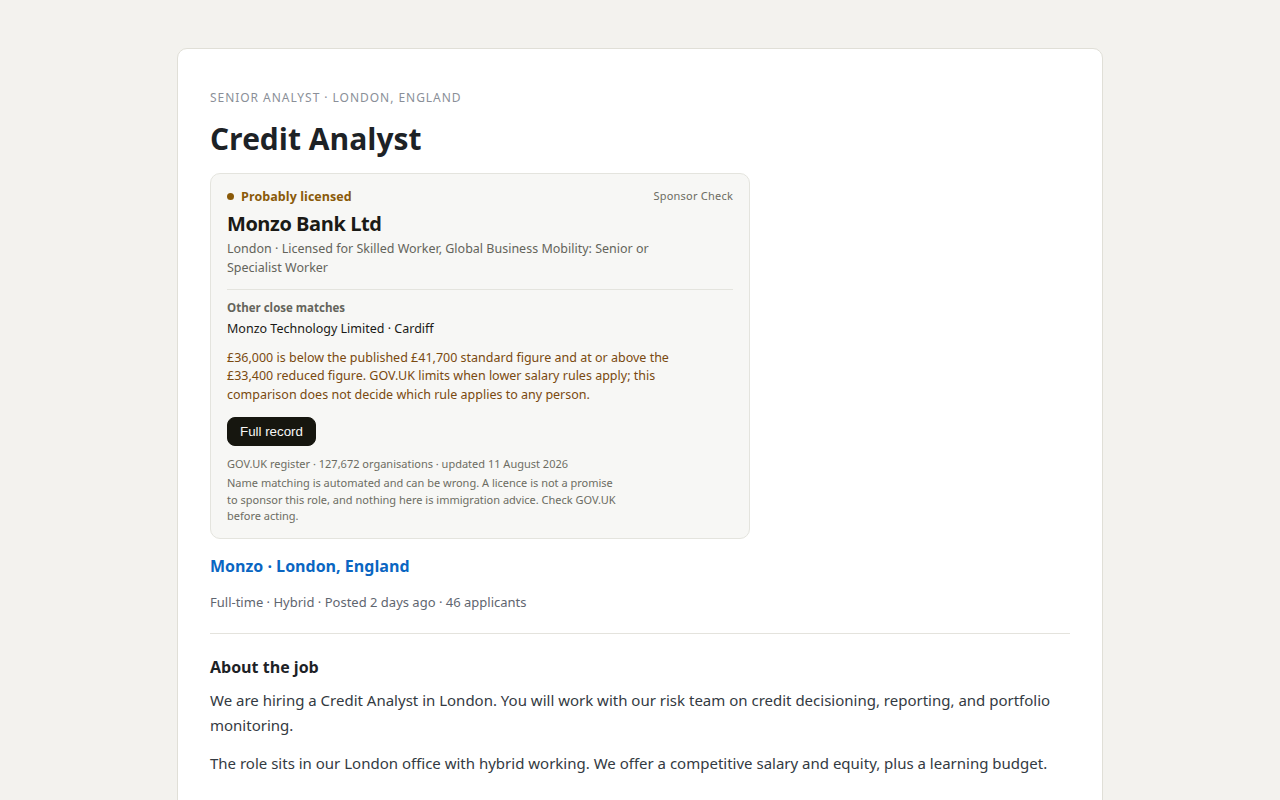
Our product. Sponsor Check is the browser extension sold by THINKINGAI LIMITED, the company identified in this site's footer. The register itself remains free, official, and public. This site is information only, not immigration advice.
Sources
- Check a job applicant's right to work — GOV.UK
- Penalties for employing illegal workers — GOV.UK
- Skilled Worker visa: your job — GOV.UK
- Explanatory memorandum to the statement of changes to the Immigration Rules: HC 997 — GOV.UK
- Temporary Shortage List: Stage 1 report — GOV.UK
- Register of licensed sponsors: workers — GOV.UK
- Immigration and Asylum Act 1999, section 84 — legislation.gov.uk
- Find an immigration adviser — GOV.UK