Free vs Paid UK Job Search Tools: What to Pay For
Which UK job-search tools are genuinely free, what a paid tool can honestly sell you, and the three payments that are never legitimate in a UK job search.
Quick answer
Almost every source of truth in a UK job search is free: the GOV.UK register of licensed sponsors, Companies House, employers' own career pages, and the published salary and going-rate tables. What a paid tool can honestly sell you is speed and convenience on top of that free data — not access to it, and not information nobody else has. Three payments are never legitimate: a fee to a recruitment agency for finding you work, any payment presented as buying sponsorship or a certificate of sponsorship, and guidance on your immigration position from somebody who is not regulated by the Immigration Advice Authority or a legal regulator.
Key takeaways
- The register of licensed sponsors is published free by GOV.UK, with no limit
on searches.
- No paid product holds sponsor data the register does not. Paid tools sell
time.
- Charging a work-seeker a fee to find them work is an investigable breach of
the rules governing recruitment agencies.
- Only a "qualified person", regulated by the Immigration Advice Authority or a
legal regulator, may give immigration advice in the UK, and you cannot get your money back if an adviser is not regulated.
- Judge any paid tool on four questions: what it does, what it costs, what data
it sees, and what its limits are.
- A sponsor licence is permission to sponsor, not a promise to sponsor any role
or any person, and nothing you buy changes that.
Disclosure
This site is published by the team behind a UK sponsor-search tool, which is a browser extension. That means we have a commercial interest in one of the categories discussed below. We have tried to be even-handed, and the honest answer for most people is that the free route is sufficient — but read this page with that interest in mind and check any claim against a vendor's own current documentation.
What is genuinely free
The register of licensed sponsors
The Register of Licensed Sponsors: Workers is the official list of organisations permitted to sponsor workers. It is published as a CSV of roughly 10.4 MB plus a web preview, and carries each organisation's name, town or city, county, licence type and rating, and the routes covered Source: GOV.UK — Register of licensed sponsors: workers. Our copy of the file, published as of 11 August 2026, holds 127,672 organisations.
It costs nothing, has no account, and imposes no search limit. Every sponsor checker on the market — ours included — reads from it. That is the fact the whole category turns on: the data is the same everywhere, because there is only one source.
Our guide to checking a sponsor licence free walks through the manual method step by step.
Companies House
Legal entity names, company numbers, group structures, filing history, and officers, all free Source: Companies House — Find and update company information. This is what turns a brand name on a job advert into the legal name the register uses.
Employers' own career pages
Free, and generally more complete and more current than any aggregated copy of the same vacancy.
The published salary rules
The general threshold, the lower floors, and the going rates for occupation codes are all published. The standard Skilled Worker salary threshold is £41,700 a year or the going rate for the occupation, whichever is higher, with lower floors from £33,400 for defined groups Source: GOV.UK — Skilled Worker visa: your job, verified against GOV.UK on 6 August 2026.
A spreadsheet
Your application tracker does not need to cost anything. Our comparison of trackers concludes that a spreadsheet suits most people, and that conclusion has not changed.
What a paid tool can honestly sell
If the data is free, what is left to sell? Three things, all real:
Time. Searching 127,672 rows by hand for each of sixty employers, matching brand names to legal names, is slow. A tool that does the match in place while you read a job advert saves minutes per employer, and minutes per employer adds up across a search.
Structure. Prompts, checklists, and templates that stop you skipping steps have value even though every individual step is free.
Convenience. Alerts, saved shortlists, exportable notes.
That is the honest list. Notice what is not on it: extra data, privileged access, or any influence on an outcome.
The claims that should stop you
| Claim | Why it fails |
|---|---|
| "Access our exclusive sponsor database" | There is one register and it is public |
| "We know which companies are hiring internationally" | Intent is not published anywhere |
| "Improve your visa approval odds" | No tool participates in a visa decision |
| "Our partner employers sponsor" | If they will not name them and the terms, treat it as marketing |
| "Sponsorship packages from £X" | Sponsorship is not a product a candidate buys |
The three payments that are never legitimate
1. A fee to find you work
Charging a work-seeker a fee to find them work is an investigable breach of the rules governing recruitment agencies. Those rules are the Employment Agencies Act 1973 and the Conduct of Employment Agencies and Employment Businesses Regulations 2003, both as amended, and from 7 April 2026 they are enforced by the Fair Work Agency, which replaced the Employment Agency Standards Inspectorate Source: GOV.UK — Complain about your recruitment agency. Complaining to the FWA is free.
2. Anything presented as buying sponsorship
A certificate of sponsorship is assigned by a licensed employer, and the published fees for it and for the immigration skills charge sit on the employer, not on the worker. An offer to sell you sponsorship is describing something the rules do not permit. Our guide to visa job scam warning signs covers how these approaches are usually packaged.
3. Guidance from an unregulated adviser
The regulator here is the Immigration Advice Authority, alongside the bodies that regulate solicitors and barristers Source: GOV.UK — Immigration Advice Authority. Section 84 of the Immigration and Asylum Act 1999 is blunt about who may act: "No person may provide immigration advice or immigration services unless he is a qualified person" Source: legislation.gov.uk — Immigration and Asylum Act 1999, s.84.
GOV.UK's adviser finder carries a warning worth repeating in full: you cannot get your money back if an adviser is not regulated Source: GOV.UK — Find an immigration adviser.
Note the boundary carefully. A tool that shows you what the public register says is providing information. Someone telling you which route to apply on, or how to present your circumstances to UKVI, is doing something that requires regulation. Software does not get an exemption by calling it a "feature".
The four-question test for any paid tool
Before paying for anything in this category, answer these. If the vendor's own documentation cannot answer them, that is your answer.
1. What does it actually do?
Not what it promises — what it does, mechanically. "Matches the employer name on the page you are viewing against a copy of the public register" is a mechanism. "Supercharges your job search" is not.
2. What does it cost, in total?
The headline price, the renewal price, the term, and how you cancel. A monthly subscription you have to email someone to cancel is a different product from one you cancel in two clicks.
3. What data does it see?
For a browser extension, this is the important question, and the permissions screen answers it. Does matching happen locally, or is the page you are viewing sent to a server? Our guide to browser permissions explains what "read your data on all websites" actually allows.
4. What are its limits, in the vendor's own words?
A vendor that states its limits plainly is easier to trust than one that does not. The limits in this category are known and unavoidable: the register shows licences rather than intentions, name matching is imperfect, and the file changes almost daily.
A sensible spending order
If you are going to spend anything, spend it in this order:
- Nothing. Run the free method for two weeks. Many people find they never
need more.
- Time-saving on the step you repeat most. For a shortlist-driven search,
that is usually employer checking. For a high-volume search, it is usually tracking.
- A regulated adviser, if you have a genuine case-specific question. This is
the one place where paying is not about convenience, and where paying the wrong person is expensive.
- Nothing else. CV rewriting services, "priority application" services, and
anything promising an outcome belong outside this list.
Work out your own cost per hour saved
"Is it worth it?" is unanswerable in the abstract and easy to answer for yourself. Spend one week running the free method and time the steps.
Most sponsorship-dependent searches spend their time in four places:
| Step | Typical time per employer | Repeated |
|---|---|---|
| Converting a brand name to a legal name | 1–2 minutes | Once per employer |
| Searching the register and reading the row | 1–2 minutes | Once per employer, then re-checks |
| Reading an advert against salary rules | 2–3 minutes | Every advert |
| Logging the application and the decision | 1–2 minutes | Every application |
Multiply by your actual volume. A search running sixty employers and twelve applications a month spends somewhere around two to four hours on those steps. That is the number a paid tool is competing against — not against the price of a coffee, and not against an imagined "10x productivity".
Two implications follow, and they point in opposite directions for different people:
- A low-volume, high-selectivity search — ten carefully chosen employers,
three applications a month — rarely justifies a subscription. The free method takes under an hour a month.
- A high-volume search — sixty employers, weekly checks, twenty applications
a month — spends real hours on repetition, and a tool that removes a step you perform two hundred times is buying back something measurable.
Neither profile is better. But the arithmetic is yours to do, and it takes one week of honest timing to do it. A subscription bought before that week is bought on a guess.
The one thing worth paying for regardless of volume
If you have a genuine case-specific question about your immigration position — a question about your circumstances rather than about published rules — that is where paying is not a convenience decision. Pay a regulated adviser, check their registration first, and treat any free answer from an unregulated source as worth exactly what it cost.
Cancelling, refunds, and subscription traps
Three practical habits:
- Note the renewal date the day you subscribe. Put it in your calendar with
the cancellation URL in the note.
- Prefer products with a visible cancellation route before you pay, not
after.
- Keep the receipt and the terms as they were when you bought. Terms change.
If a trader misleads you about price, terms, or what a product does, that is consumer-protection territory. Misleading adverts can be reported to the Advertising Standards Authority, and fraud in England and Wales to reportfraud.police.uk or 0300 123 2040 Source: GOV.UK — Report suspicious emails and websites.
What we recommend, plainly
For most people running a UK job search that depends on sponsorship, the free route is sufficient:
- Build the shortlist from the register.
- Convert brand names to legal names on Companies House.
- Read adverts on employers' own career pages.
- Check salary against the published thresholds and going rates.
- Track everything in a spreadsheet with dates.
Buy time only where you have measured that you are spending it. And treat any purchase that claims to affect an immigration outcome as outside the category entirely — no product can do that, and the ones that say they can are describing something the rules do not permit.
The bottom line
The information in a UK sponsorship-dependent job search is free, published, and identical wherever you read it. Tools sell speed on top of it, and some of them sell it honestly. Start free, measure where your time actually goes, and pay only for that step.
Then hold the line on the three payments that are never legitimate: fees to find you work, anything presented as buying sponsorship, and advice from someone not regulated to give it. And remember what even a perfect toolkit leaves untouched — a licence is permission to sponsor, not a promise to sponsor any role or any person.
This page is information, not immigration advice. This site is not affiliated with the Home Office or GOV.UK. For your own circumstances, check GOV.UK or speak to an adviser registered with the Immigration Advice Authority or a regulated solicitor.
Frequently asked questions
Is checking the UK sponsor register free?
Yes. GOV.UK publishes the register at no cost, as a downloadable CSV and a web preview, with no limit on how many times you search it.
Do paid sponsor checkers have extra data?
No. There is a single published register and every checker reads from it. What a paid tool can offer is speed and convenience, not additional sponsor data.
Should I pay a recruitment agency to find me a job?
Charging a work-seeker a fee to find them work is an investigable breach of the rules governing agencies. Complaining to the Fair Work Agency is free.
Can I pay someone for sponsorship?
A certificate of sponsorship is assigned by a licensed employer, and the published fees sit on the employer. Any offer to sell sponsorship to a candidate is describing something the rules do not allow.
Is it worth paying for immigration advice?
If you have a case-specific question, paying a regulated adviser is reasonable. Paying an unregulated one is not: only a qualified person may provide immigration advice in the UK, and you cannot get your money back if an adviser is not regulated.
How do I check whether an adviser is regulated?
Use the GOV.UK adviser finder, which covers advisers regulated by the Immigration Advice Authority as well as solicitors and barristers regulated by their own professional bodies.
What is a fair price for a job-search tool?
There is no benchmark worth quoting, because the products differ. The useful question is whether it saves you time on a step you actually repeat, and whether you can cancel it easily.
Are free tools less accurate?
Not inherently. The underlying register is identical. Accuracy differences come from how a tool matches employer names, not from price.
Do I need a paid CV tool?
Free checkers are usually enough to test whether a CV parses correctly, which is the part that matters. Our guide to ATS CV checkers covers what they can and cannot measure.
What should I never pay for?
A fee to be found work, anything presented as buying sponsorship, and guidance on your immigration position from anyone outside the Immigration Advice Authority's remit or the legal professions.
How do I avoid subscription traps?
Note the renewal date when you subscribe, check the cancellation route before paying, and keep a copy of the terms as they stood at purchase.
Does a paid tool improve my chances of getting sponsored?
No tool takes part in an employer's hiring decision or in a visa decision. A sponsor licence is permission to sponsor, not a promise to sponsor any role or any person.
What if I have already paid someone unregulated?
GOV.UK warns that money paid to an unregulated adviser cannot be recovered. Report the matter through the fraud reporting routes, and take any live immigration question to a regulated adviser.
Where do I report a misleading job-search product?
Misleading adverts go to the Advertising Standards Authority; suspected fraud goes to reportfraud.police.uk or 0300 123 2040 in England and Wales, and to Police Scotland in Scotland.
Last reviewed 2026-08-08 by Job Search Tools UK Editorial Team. Figures on this page are checked against GOV.UK on the review date. Rules, fees, and salary floors change — always confirm against GOV.UK before you act. Spotted an error?
Check the employer without leaving the job advert
- See the legal sponsor name, town, routes, rating, and close matches on the page.
- Your checks and job-page text stay on your computer; the extension makes no network requests.
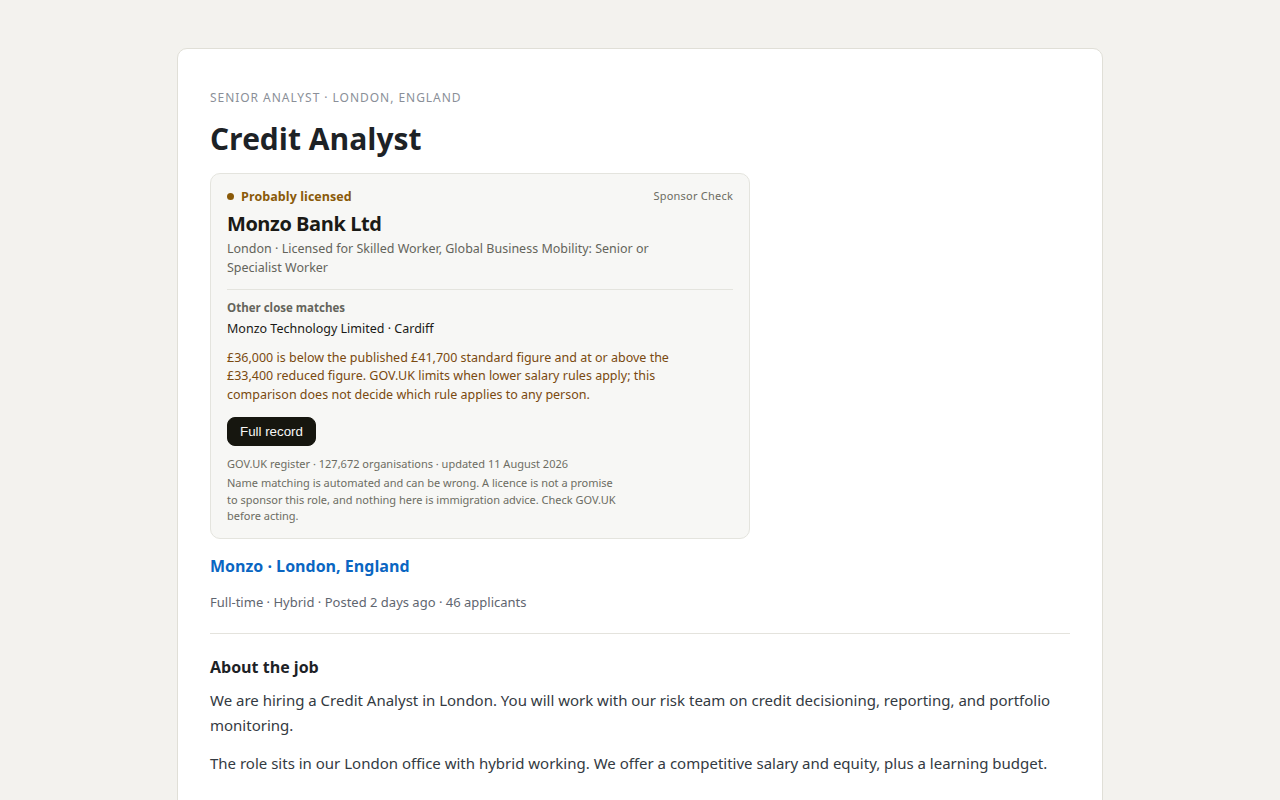
Our product. Sponsor Check is the browser extension sold by THINKINGAI LIMITED, the company identified in this site's footer. The register itself remains free, official, and public. This site is information only, not immigration advice.
Sources
- Register of licensed sponsors: workers — GOV.UK
- Find and update company information — Companies House
- Skilled Worker visa: your job — GOV.UK
- Immigration skills charge — GOV.UK
- Certificates of sponsorship — GOV.UK
- Complain about your recruitment agency — GOV.UK
- Immigration and Asylum Act 1999, section 84 — legislation.gov.uk
- Immigration Advice Authority — GOV.UK
- Find an immigration adviser — GOV.UK
- Report suspicious emails and websites — GOV.UK