ATS CV Checkers: What They Actually Score
What an ATS really does with your CV, what free ATS checkers can and cannot measure, and the parsing fixes that make a genuine difference.
Quick answer
An applicant tracking system (ATS) is database software recruiters use to store, search, and manage applications. Most do not automatically reject CVs on a score. What they do is parse your CV into structured fields, and if parsing fails, your experience becomes invisible to the recruiter's search. A free ATS CV checker can usefully test that parsing — whether your name, dates, job titles, and skills extract cleanly — and can compare your wording against a job description. It cannot tell you how a specific employer's system ranks you, because that depends on configuration no external tool can see. Treat the parsing result as real and the "score out of 100" as a rough prompt.
Key takeaways
- An ATS is a database first and a filter second.
- The common claim that "75% of CVs are rejected by robots" has no verifiable
source. Be sceptical of any tool that leads with it.
- Parsing failures are the real, fixable problem: tables, columns, headers,
graphics, and text inside images.
- A checker's score is generated by that checker, not by any employer's system.
- UK data protection law gives you rights when organisations use your data for
automated decision-making or profiling.
- Free checkers are usually enough. Paid "guaranteed pass" claims are not
something any tool can deliver.
Disclosure
This site is published by the team behind a UK sponsor-search tool. We review job-search products, including categories our own product sits in, so treat this page as informed but interested, and check any claim against the vendor's own current documentation before you rely on it.
What an ATS actually is
A database, not a bouncer
The mental image most people have — a machine reading your CV and binning it — is mostly wrong. An applicant tracking system is closer to a CRM: it receives applications, stores them, and gives recruiters a way to search, tag, and move candidates through stages.
The critical step happens on receipt. The system takes your document and tries to turn it into structured data: name, contact details, employment history with dates, education, and skills. That is parsing, and it is where most damage occurs.
If parsing works, a recruiter searching "Python, Manchester, 5 years" can find you. If parsing fails, you exist in the database as an unreadable blob, and no search will surface you. You were not rejected. You were never retrieved.
Where filtering does happen
Filtering is real, but it is usually cruder and more visible than people imagine. It typically takes the form of knockout questions on the application form:
- Do you have the right to work in the UK?
- Do you now or will you in the future require sponsorship?
- Do you have a driving licence?
- Do you have X years of experience with Y?
These are answered by you, in a form field, and they can genuinely route your application. That is a far bigger deal than font choice, and it is the part of the process most CV advice ignores.
Note the sponsorship question in particular. It is asked directly, it is answered directly, and no CV formatting trick changes the outcome. What matters there is whether the employer holds a sponsor licence at all — see our guide to checking an employer's sponsor licence free.
The statistic to stop repeating
You will see "75% of CVs never reach a human" on tool marketing pages, LinkedIn posts, and CV-writing services. We have not found a credible primary source for it. It appears to circulate by repetition.
A tool that opens with an unsourced scare statistic is telling you something about its marketing standards. That does not make the tool bad, but it is a reasonable prompt to check the rest of its claims.
What ATS checkers actually measure
The four things they can genuinely test
| What it tests | How reliable | Why it matters |
|---|---|---|
| Text extraction | High | If text cannot be read, nothing else matters |
| Field parsing | Medium to high | Names, dates, titles, employers landing in the right fields |
| Keyword overlap with a job description | Medium | Rough proxy for relevance; easy to game and easy to overdo |
| Formatting risk flags | Medium | Tables, columns, images, headers and footers |
The first two are the reason to use one of these tools at all. Upload your CV, and see whether the tool can read back your job titles and dates correctly. If it garbles them, a real ATS may well do the same.
The two things they cannot test
How a specific employer ranks you. Every ATS deployment is configured differently: different fields, different screening questions, different weightings, different integrations. No external checker sees any of that.
Whether a human will like your CV. Recruiters skim. Clarity, relevance, and a readable first third of page one still decide more outcomes than any score.
About that score
Most checkers return a number. Understand what it is: the tool's own opinion, generated by the tool's own rules, presented as a number because numbers feel authoritative.
Two checkers will give the same CV different scores. Neither is "the ATS score", because there is no such thing. Use the score as a nudge towards the specific issues listed underneath it, and ignore the number itself.
The parsing problems worth fixing
These are the changes that actually move the needle, ordered by how often they cause real damage.
1. Multi-column layouts
Two-column CVs look designed and parse badly. Many parsers read left to right across the whole page, interleaving your skills sidebar with your job history into nonsense.
Fix: single column, top to bottom.
2. Text inside images or graphics
A CV exported as an image, or with a graphic header containing your name and contact details, gives the parser nothing to read.
Fix: real, selectable text. Test by opening the PDF and trying to select your own name.
3. Tables
Skills matrices and date tables are common and often parse into a single run-on string.
Fix: simple lines and bullets instead of table cells.
4. Headers and footers
Contact details placed in the document header are sometimes skipped entirely. People then wonder why nobody called.
Fix: put your name, email, and phone in the body of the document, at the top.
5. Unusual section names
"My Journey" and "Where I've Made an Impact" are lovely and unparseable. The parser is looking for conventional labels.
Fix: Experience, Education, Skills. Boring wins here.
6. Date formats
"Summer '23 – present" is human. "06/2023 – Present" is machine-readable and still human enough.
Fix: consistent numeric months and four-digit years.
7. The file format
PDF is generally safe if the text is selectable. Some older systems handle .docx more reliably. If an application form specifies a format, follow it exactly rather than optimising.
Fix: keep a clean .docx and a text-selectable PDF of the same CV.
Keywords, honestly
What actually helps
Use the words the job description uses, where they are true of you. If the ad says "stakeholder management" and you have done exactly that but called it "working with clients", change your phrasing to theirs. That is not gaming the system; it is speaking the reader's language.
What does not help
- Keyword stuffing in white text. Parsers extract hidden text, and recruiters
see it. It reads as dishonesty.
- A wall of every technology you have ever touched. It dilutes the genuine
matches and invites questions you cannot answer.
- Claiming skills you do not have. This is the fastest way to fail an interview
you should never have had.
The realistic gain
Aligning vocabulary with the job description is worth doing and takes ten minutes per application. Beyond that, returns fall off sharply. Time is better spent on which roles you apply to than on the twentieth keyword.
AI screening and your rights
Recruitment tools increasingly do more than parse. Some score, rank, or infer attributes about candidates.
Under UK data protection law you have a set of rights over your personal data, including the right to be informed about how your data is used, to access it, to have incorrect data corrected, and to object to processing in certain circumstances. GOV.UK also states that you have rights "when an organisation is using your personal data for automated decision-making processes (without human involvement) or profiling" Source: GOV.UK — Data protection. Complaints go to the Information Commissioner's Office.
If a decision about you was made by automation and it matters to you, you can ask the employer about it. Whether any particular process is lawful is a question for the ICO or a qualified adviser, not for a website.
How to judge any ATS checker
Four questions. They work on every tool in this category.
- What does it do with my CV after the check? Does it store it, use it for
training, or share it with recruiters? The answer should be in the privacy policy, not a marketing page.
- What does its score actually measure? If the tool cannot explain its
scoring in plain language, the number means nothing.
- What does it claim? "Improves parsing" is a claim a tool can support.
"Guaranteed to pass the ATS" is not something any external tool can deliver.
- Does it need an account, and why? Some tools require sign-up purely to
build a candidate database.
Question one matters most for international candidates. A CV carries your nationality, visa status, address history, and education — a rich profile. Read what happens to it.
A sensible workflow
- Write one clean, single-column master CV with conventional section headings.
- Run it through one free ATS checker. Read the parsing output, not the score.
- Fix anything the parser got wrong: garbled dates, missing employers, a name
it could not find.
- Save that corrected version as your master.
- Per application, adjust vocabulary to match the job description where it is
truthful. Ten minutes, not an hour.
- Answer the screening questions honestly, especially the sponsorship one.
- Spend the time you saved on checking whether the employer can actually
sponsor.
That last step is the one people skip. A perfectly parsed CV sent to an employer with no sponsor licence achieves nothing. The GOV.UK Register of Licensed Sponsors: Workers held 127,672 organisations in the file published as of 11 August 2026 Source: GOV.UK — Register of licensed sponsors: workers, and it is free to search. A licence is permission to sponsor; it is not a promise to sponsor any role or any person.
What to pay for, and what not to
| Thing | Worth paying for? |
|---|---|
| Basic ATS parsing check | No — free versions do this |
| Keyword comparison against one job description | No — free versions do this |
| Human CV review by someone who knows your industry | Sometimes |
| "Guaranteed ATS pass" | No — not deliverable |
| "We'll get your CV to recruiters" | Be careful; ask exactly which recruiters and what they receive |
| Sponsor licence checking | No — the register is free and official |
Nobody can charge you for the sponsor register. It is a free public file. Any tool that checks it is reformatting public data, which can be worth paying for in convenience but never in access.
UK CV conventions a checker will not tell you about
ATS checkers are built mostly around American résumé conventions. Several things they flag, or fail to flag, differ in the UK.
| Convention | UK practice | What checkers often say |
|---|---|---|
| Photo | Not included | Some tools suggest adding one |
| Date of birth, marital status | Not included | Rarely flagged |
| Length | Two pages is normal | Tools often push for one |
| Spelling | "Organised", "programme", "specialise" | US tools may flag as errors |
| Address | City and region is enough; full address is unnecessary | Tools may want a full address |
| Referees | "References available on request", or omitted | Sometimes flagged as missing |
| Personal statement | A short profile at the top is common | Often treated as filler |
None of these are parsing problems, and none of them will stop a system reading your CV. But following American conventions on a UK application is a small, avoidable signal that you have not adapted, and a human notices it even when the parser does not.
The one that matters for sponsorship
Where you put your work-authorisation position. The usual advice is to keep it off the CV entirely and raise it in the covering message. There is a narrow exception: if you already hold permission to work, one short line near your contact details saves everyone a round of questions.
"Right to work in the UK — [route], valid until [date]."
If you would need sponsorship, do not put it in the CV. Put it in the message, where it can be phrased as a question rather than a caveat. Before you send anything, confirm the employer can sponsor at all — our guide to checking an employer's sponsor licence free covers the lookup.
A checker's privacy checklist
Before you upload your CV to anything, run through five questions. Your CV is one of the richest personal documents you own: full name, contact details, employment history, education, and often nationality or visa status.
- Is there a privacy policy, and does it name a company? No named entity is
the end of the assessment.
- Does it say how long the CV is kept? "As long as necessary" is not an
answer.
- Is your CV used to train models or build a candidate database? Some tools
do this and disclose it in a sentence most people skip.
- Is it shared with recruiters? Some free checkers are lead-generation for
a recruitment business. That may be fine — but you should know.
- Can you delete it? UK data protection law gives you the right to have
data erased, among other rights Source: GOV.UK — Data protection. A tool with no delete option is telling you something.
If a checker requires an account before it will parse a single document, the account is usually the product.
The bottom line
Use an ATS checker once, on your master CV, and read the parsing output rather than the score. Fix the things it could not read: columns, tables, image text, header contact details, odd section names, inconsistent dates. That is the whole value.
Then stop optimising. The screening question about sponsorship, the salary floor, and whether the employer holds a licence decide more outcomes than any formatting change ever will — and all three are free to check before you spend an application on them.
This page is information, not legal, employment, or immigration advice. This site is not affiliated with the Home Office or GOV.UK. Product names and trademarks belong to their owners.
Frequently asked questions
Do ATS systems automatically reject CVs?
Most do not reject on a score. The bigger risk is that your CV parses badly and never appears in a recruiter's search. Explicit rejection more often comes from knockout questions you answer on the application form.
What is an ATS CV checker?
A tool that uploads your CV, attempts to parse it the way an applicant tracking system would, and reports what it could extract, plus a comparison against a job description.
Are ATS checkers accurate?
They are reasonably accurate about parsing, which is the part that matters. They cannot know how any specific employer's system is configured, so their scores are indicative rather than authoritative.
Is "75% of CVs are rejected by ATS" true?
We have not found a credible primary source for that figure. Treat it as marketing copy rather than data.
What is the best CV format for an ATS?
A single-column document with conventional headings, selectable text, consistent numeric dates, and no critical information in headers, footers, tables, or images. Keep both a .docx and a text-based PDF.
Should I use a PDF or Word document?
PDF is generally fine if the text is selectable. Some systems parse .docx more reliably. If the application form specifies a format, use that one.
Does keyword stuffing work?
No. Hidden or excessive keywords are extracted and visible to recruiters, and they read as dishonest. Matching the job description's genuine vocabulary does help.
Do ATS checkers see my personal data?
Usually yes — your CV contains a great deal of it. Read the tool's privacy policy to see whether it stores, reuses, or shares your document before you upload.
What rights do I have if a machine screened me out?
UK data protection law gives you rights over your personal data, including where it is used for automated decision-making or profiling. You can ask the organisation and complain to the Information Commissioner's Office.
Can an ATS see my visa status?
Only what you tell it. Sponsorship and right-to-work questions are usually asked directly on the application form, and your answers are stored with your application.
Do I need a different CV for every job?
Not a different CV — a different top third. Adjust the summary and the most relevant bullets to the job description, and leave the structure alone.
Are paid ATS tools better than free ones?
For parsing checks and keyword comparison, free tools generally do the same job. Paid value, where it exists, is usually human review rather than automation.
How long should a UK CV be?
Two pages is the common convention for most roles, with academic and senior technical CVs sometimes longer. Parsing does not care about length; recruiters do.
Should I include a photo on a UK CV?
The UK convention is not to. It adds no parseable information and introduces bias risk into the process.
Does a good ATS score mean I will get an interview?
No. The score belongs to the checker, not to the employer. Relevance, timing, and whether the employer can actually sponsor matter far more.
What should I check before applying at all?
Whether the salary clears the threshold that applies to you, whether the occupation meets the skill level, and whether the employer holds a sponsor licence. Those three checks are free and rule out more roles than any CV change will fix.
Last reviewed 2026-08-06 by Job Search Tools UK Editorial Team. Figures on this page are checked against GOV.UK on the review date. Rules, fees, and salary floors change — always confirm against GOV.UK before you act. Spotted an error?
Check the employer without leaving the job advert
- See the legal sponsor name, town, routes, rating, and close matches on the page.
- Your checks and job-page text stay on your computer; the extension makes no network requests.
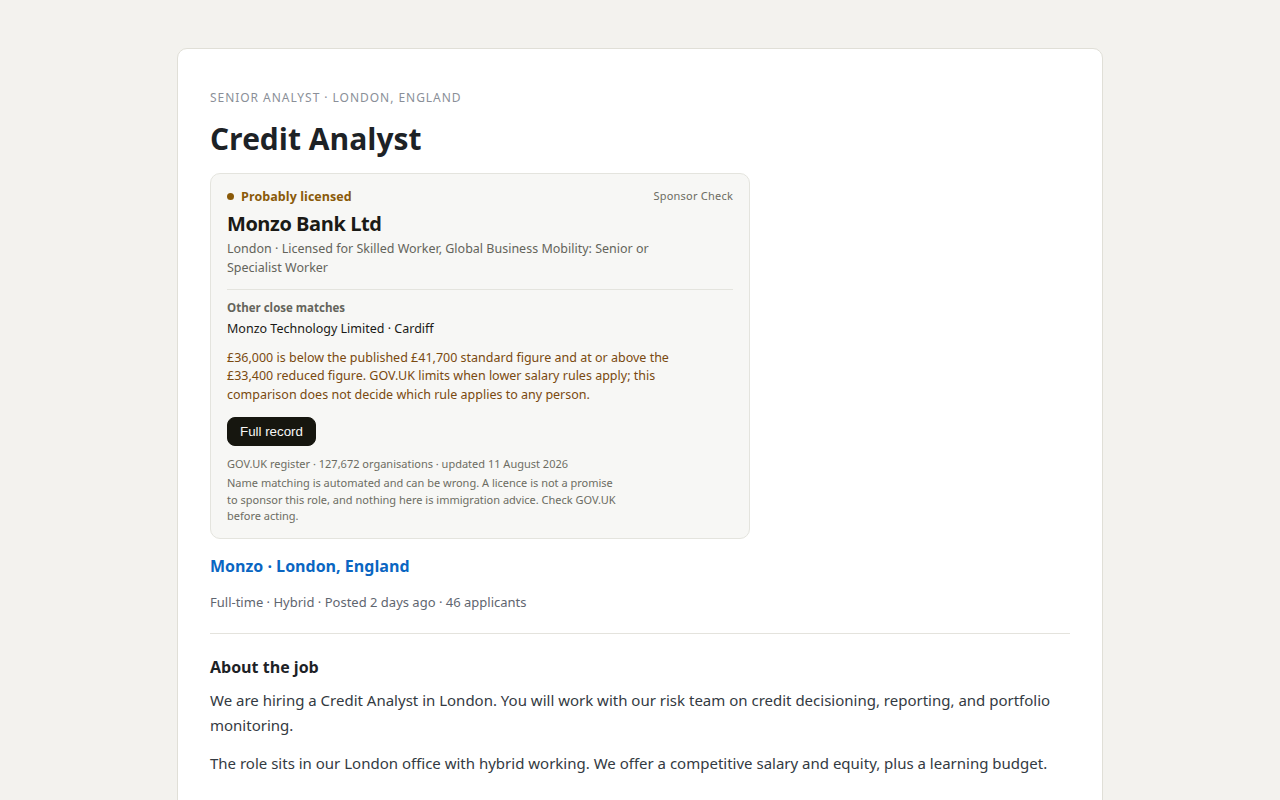
Our product. Sponsor Check is the browser extension sold by THINKINGAI LIMITED, the company identified in this site's footer. The register itself remains free, official, and public. This site is information only, not immigration advice.