Visa Job Scams in the UK: The Warning Signs
How UK visa and sponsorship job scams work, the eight signals that give them away, what legitimate tools never ask for, and exactly where to report one.
Quick answer
The clearest signal of a UK visa or sponsorship scam is a request for money. No legitimate employer or recruitment agency may charge you to find you work, and GOV.UK is explicit that the employer — not the worker — pays the £525 certificate of sponsorship fee and the Immigration Skills Charge. If anyone asks you to pay for a job, a certificate of sponsorship, a "visa processing fee", or a "sponsorship slot", that is the answer. Report it to reportfraud.police.uk or 0300 123 2040 in England and Wales, forward suspicious emails to report@phishing.gov.uk, and forward suspicious texts to 7726.
Key takeaways
- Payment requests are the single most reliable warning sign.
- Charging a work-seeker a fee to find them work breaches the rules the Fair
Work Agency enforces. Complaining to the FWA is free.
- Only a "qualified person" may give immigration advice in the UK. Unregulated
advisers are a legal problem and a financial one.
- A real certificate of sponsorship cannot be bought, sold, or transferred.
- Nobody can promise a visa outcome. No one can guarantee an application will
succeed.
- Verify the employer on the free GOV.UK register before you believe anything
else in the conversation.
- A sponsor licence is permission to sponsor, not a promise to sponsor any role
or any person.
Disclosure
This site is published by the team behind a UK sponsor-search tool. We have a commercial interest in the job-search tools category. Nothing in this article requires you to buy anything, and every check described here is free.
Why international candidates are targeted
Fraud follows urgency, and few situations produce more urgency than a visa timeline. Someone whose permission to stay expires in eleven weeks, or who has spent months applying without an offer, is under a specific kind of pressure that scammers understand and use.
Three features of the sponsorship system make it easy to exploit:
- It is genuinely complicated. Defined and undefined certificates, going
rates, occupation codes, RQF levels. Complexity makes invented processes sound plausible.
- Real money does change hands. Employers really do pay hundreds or
thousands of pounds in fees. A fraudster asking for money is describing something that exists — just not something you pay.
- Verification feels hard. People assume checking an employer's licence
requires a paid tool or an insider. It does not. It is a free public file.
That third point is the one worth internalising, because it removes the scammer's main advantage.
The eight warning signs
1. Any request for money
This is the one that ends the conversation. Common framings:
- "Certificate of sponsorship fee" — the employer pays £525 on Worker routes,
and GOV.UK states the worker cannot be charged Source: GOV.UK — Certificates of sponsorship.
- "Immigration Skills Charge contribution" — GOV.UK says "You must pay the
immigration skills charge yourself", addressed to the employer, and it cannot be recovered from the worker Source: GOV.UK — Immigration skills charge.
- "Agency registration fee" or "job placement fee" — charging a work-seeker a
fee to find them work is a breach of the rules enforced by the Fair Work Agency, which began operating on 7 April 2026 and replaced the Employment Agency Standards Inspectorate Source: GOV.UK — Making a complaint about your recruitment agency.
- "Refundable deposit", "training materials", "uniform", "DBS check", "equipment"
— all standard framings for the same request.
There is no legitimate version of "pay us and the sponsorship happens".
2. A promised outcome
No employer, agency, or adviser can promise that a visa will be granted. UKVI decides applications. Language like "approval assured", "100% success", or "sponsorship secured on payment" describes something the system does not offer.
A genuine employer will talk about a certificate being assigned, and about indicative processing times — GOV.UK gives three weeks from outside the UK and eight weeks inside it Source: GOV.UK — Skilled Worker visa. They will not tell you the answer in advance.
3. A job offer without a real process
Offers that arrive without an interview, or after a five-minute chat on a messaging app, are a strong signal. So are offers for roles you never applied to, and offers that arrive within hours of a first message.
Sponsorship costs an employer real money. Nobody spends £525 plus a skills charge of up to £6,600 across five years on someone they have not interviewed.
4. The wrong channels
Watch for:
- A "company email" on a free mail domain rather than the company's own.
- A domain that is nearly right: an extra hyphen, a swapped letter, a
.co
where the real site is .co.uk.
- Interviews conducted entirely by text chat, with no voice or video at any
point.
- Pressure to move the conversation off the job board immediately.
5. Pressure and deadlines
"The allocation closes tonight." "We have three sponsorship slots left." "Another candidate is waiting." Urgency exists to stop you checking. Certificate allocations are not sold on a countdown, and a real employer will wait a day while you verify something.
6. Requests for documents too early
Passport scans, biometric residence details, bank details, and National Insurance numbers belong later in a genuine process, after identity is established on both sides. A right-to-work check is a real thing every UK employer must do — using an online share code, a manual document check, or an identity service provider Source: GOV.UK — Check a job applicant's right to work — but it happens with a real employer you have verified, not with a stranger in a chat window.
Never send a passport scan to an unverified contact. If you must share a share code, remember it is time-limited and specific.
7. Unregulated "immigration advisers"
This one is a legal matter, not just a financial one. Section 84 of the Immigration and Asylum Act 1999 states: "No person may provide immigration advice or immigration services unless he is a qualified person" Source: legislation.gov.uk — Immigration and Asylum Act 1999, section 84.
Qualified means registered with the Immigration Advice Authority, or a solicitor or barrister regulated by their professional body Source: GOV.UK — Find an immigration adviser. That page also carries a blunt warning: "You cannot get your money back if an adviser is not regulated."
Anyone offering paid immigration advice should be checkable on the IAA's adviser finder. If they are not there and not a regulated lawyer, stop.
8. Sponsorship offered as a product
"Buy a certificate of sponsorship." "Sponsorship packages from £4,000." "Guaranteed sponsorship, pay after approval." A certificate is assigned by a licensed employer for a genuine role that meets the immigration requirements. It is not a commodity, it cannot be transferred between people, and it does not exist independently of a job.
Arrangements where money is paid for a certificate can put the worker's own position at risk as well as the employer's. What that means for any individual is a question for a regulated adviser, not for a website.
What legitimate tools never ask for
The same logic applies to job-search software.
| A legitimate job-search tool… | A tool to be wary of… |
|---|---|
| Explains what data it collects and where it goes | Is vague about storage and sharing |
| Works without needing your passport or visa documents | Asks for immigration documents |
| Charges, if at all, for convenience | Charges for access to public data |
| Says what its limits are | Claims to know who will sponsor you |
| Asks for the narrowest browser permissions it needs | Asks to read all sites without explaining why |
| Lets you export or delete your data | Locks your history in |
Two specific red lines:
- No tool needs your passport. A sponsor checker reads a company name.
- Nobody should charge you for the sponsor register. It is a free public
file on GOV.UK. Tools may charge for speed or interface; the underlying data is free to everyone.
The two-minute verification that defeats most of this
- Get the employer's legal name. Not the brand in the message — the
registered name. Companies House is free Source: GOV.UK — Find and update company information.
- Search the sponsor register. The GOV.UK Register of Licensed Sponsors:
Workers held 127,672 organisations in the file published as of 11 August 2026 Source: GOV.UK — Register of licensed sponsors: workers. If the "employer" is not there, they cannot sponsor anyone.
- Check the contact independently. Find the company's real website through
a search engine, not through a link in the message. Call the switchboard number on that site and ask for the person who contacted you.
- Check the salary against the rules. The Skilled Worker standard threshold
is £41,700 a year or the going rate for the occupation, whichever is higher, with lower floors of £33,400 and £37,500 for defined groups Source: GOV.UK — When you can be paid less. Verified against GOV.UK on 6 August 2026. An offer far below the floor for a sponsored role does not add up.
Step three is the one people skip, and it is the one that catches impersonation of real companies. Scammers use genuine employer names constantly. The company is real; the person contacting you is not.
Our guide to checking an employer's sponsor licence free covers the register lookup in detail.
Where to report
| What happened | Where to report |
|---|---|
| Suspicious email | Forward to report@phishing.gov.uk |
| Suspicious text message | Forward to 7726, free of charge |
| Fraud in England and Wales | reportfraud.police.uk or 0300 123 2040 |
| Fraud in Scotland | Police Scotland |
| Misleading advertising | The Advertising Standards Authority |
| A recruitment agency charging you fees | The Fair Work Agency — free |
| An unregulated immigration adviser | The Immigration Advice Authority |
Reporting channels are from GOV.UK Source: GOV.UK — Report suspicious emails, websites and phishing.
Report even if you did not lose money and even if you feel embarrassed. Reports are how patterns get identified, and the person who reports a fake listing today protects the person who sees it tomorrow.
If you have already paid
This is not legal advice, and what applies to you depends on facts we cannot see. In general terms, the steps people are usually told to take are:
- Contact your bank immediately and tell them it was a scam payment. Speed
matters.
- Report the fraud through the channels above and keep the reference
number.
- Keep every message, including the ones you might find embarrassing. They
are evidence.
- Change passwords on any account you shared credentials with, and enable
two-factor authentication.
- If you shared identity documents, treat that as an identity theft risk
and monitor accounts.
- If your immigration position may be affected, speak to a regulated
adviser rather than to anyone who contacted you about the problem. Follow-up scams targeting people who have already been defrauded are common.
How the approach arrives
The warning signs are the same everywhere, but the opening move differs by channel. Knowing the shape helps you spot it in the first thirty seconds.
Messaging apps
An unsolicited message from a "recruiter" who found your profile, moving quickly to a role that fits you suspiciously well. The tell is the speed: a real recruiter has a process; this one has an offer.
Legitimate recruiters do contact people cold. What they do not do is conduct an entire hiring process inside a chat app and then ask for money.
Fake job listings on real boards
Scam listings appear on genuine job boards. The board is real; the advertiser is not. Common signals: a salary well above the market for the role, a company name that almost matches a real one, and an application process that moves off the board immediately.
Cloned company emails
A domain one character away from the real one, or a free mail account using the company's name. This is why contacting the company through a number on its own website matters more than anything in the message.
"Agency" websites that look complete
A full website, logos, testimonials, a Companies House number that belongs to someone else. Websites are cheap. Check the company number against Companies House and see whether the name and address match what the site claims.
Social media groups
Groups aimed at people moving to the UK are targeted heavily, and posts often come from accounts that look like community members. "Falsely representing oneself as a consumer" is itself a banned commercial practice in the UK, and it is a standard technique here.
The follow-up scam
If you have already been defrauded, expect a second approach offering to recover your money for a fee. Treat any unsolicited recovery offer as a fresh attempt.
Three things that are true and worth remembering
People fall for these schemes because parts of the story are genuinely true. Holding the accurate version makes the false version obvious.
- Employers really do pay to sponsor. £525 for a certificate on Worker
routes, plus a skills charge of up to £6,600 across five years for a medium or large sponsor. All of it paid by the employer, none of it by you.
- Certificates really are numbers, not documents. So "we'll send you your
CoS number" is a normal sentence. What is not normal is being asked to buy it.
- Sponsorship really is competitive and slow. So urgency feels plausible.
But no legitimate process resolves urgency by taking a payment from the candidate.
Hold all three, and the fraud has nowhere to stand.
The bottom line
One rule catches most of it: you do not pay to be sponsored. The employer pays the certificate fee and the skills charge, an agency cannot charge you to find you work, and nobody can sell you a certificate or promise you a visa.
Everything else is verification, and all of it is free: the legal name from Companies House, the licence from the GOV.UK register, and the phone number from the company's own website rather than the message in your inbox. Two minutes of that defeats almost every version of this fraud.
This page is information, not legal or immigration advice. This site is not affiliated with the Home Office or GOV.UK. Company names and trademarks belong to their owners and are used for identification only.
Frequently asked questions
Do I have to pay for a certificate of sponsorship?
No. GOV.UK states the employer pays the certificate fee — £525 on Worker routes — and cannot recover it from the worker. Any request for you to pay it is a warning sign.
Can a recruitment agency charge me to find me work?
No. Charging a work-seeker a fee to find them work breaches the rules enforced by the Fair Work Agency, which replaced the Employment Agency Standards Inspectorate on 7 April 2026. Complaining to the FWA is free.
How can I tell if a UK job offer is fake?
Check whether the employer is on the GOV.UK sponsor register under its legal name, contact the company through a number you found independently, and treat any payment request as decisive. Offers without a real interview are a strong signal.
Can someone sell me a certificate of sponsorship?
No. A certificate is assigned by a licensed employer for a specific genuine role and a specific person. It cannot be bought, sold, or transferred.
Is it legal for someone to charge me for immigration advice?
Only if they are a qualified person — registered with the Immigration Advice Authority, or a regulated solicitor or barrister. GOV.UK warns that you cannot get your money back if an adviser is not regulated.
Where do I report a job scam in the UK?
reportfraud.police.uk or 0300 123 2040 in England and Wales, and Police Scotland in Scotland. Forward suspicious emails to report@phishing.gov.uk and suspicious texts to 7726.
Can anyone promise me a UK visa?
No. UKVI decides applications, and no employer, agency, or adviser can guarantee an outcome. Promises of assured approval are a warning sign in themselves.
Should I send my passport to a recruiter?
Not to an unverified one. Right-to-work checks are real and legally required, but they happen with an employer you have confirmed exists, later in a genuine process.
Why do scammers use real company names?
Because it survives a quick search. This is exactly why you should contact the company through a number on its own website rather than any contact detail in the message you received.
Are sponsor-checking tools that charge money a scam?
Not necessarily. The register is free, so nobody can sell you access to it, but tools may legitimately charge for convenience. A tool claiming to know which employers will sponsor you is claiming something no public data supports.
What if a job ad quotes a salary far below the threshold?
Treat it as a mismatch worth questioning. Sponsored Skilled Worker roles generally need £41,700 or the going rate, whichever is higher, with lower floors for defined groups.
Does being on the sponsor register mean an offer is genuine?
No. It means the organisation is permitted to sponsor. Impersonation of genuinely licensed employers is common, which is why independent contact matters more than the register hit alone.
What if I already sent money?
Contact your bank straight away, report the fraud and keep the reference, keep all messages, and change any shared passwords. If your immigration position may be affected, speak to a regulated adviser.
Are there scams aimed at people who were already scammed?
Yes, and they are common. Anyone contacting you offering to recover your money for a fee should be treated as a second fraud attempt.
Can I check whether an immigration adviser is regulated?
Yes. The Immigration Advice Authority publishes an adviser finder, and solicitors and barristers can be checked with their own regulators.
Last reviewed 2026-08-06 by Job Search Tools UK Editorial Team. Figures on this page are checked against GOV.UK on the review date. Rules, fees, and salary floors change — always confirm against GOV.UK before you act. Spotted an error?
Check the employer without leaving the job advert
- See the legal sponsor name, town, routes, rating, and close matches on the page.
- Your checks and job-page text stay on your computer; the extension makes no network requests.
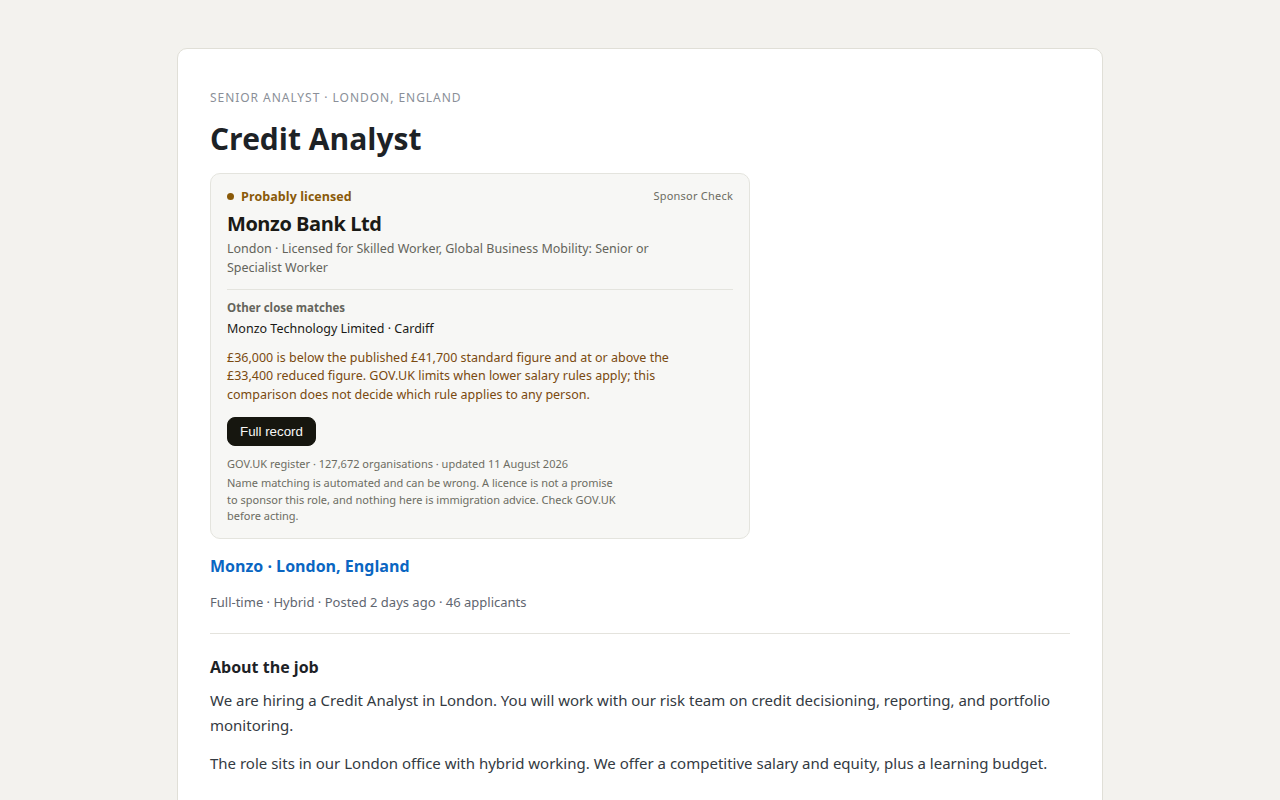
Our product. Sponsor Check is the browser extension sold by THINKINGAI LIMITED, the company identified in this site's footer. The register itself remains free, official, and public. This site is information only, not immigration advice.
Sources
- Certificates of sponsorship — GOV.UK
- Immigration skills charge — GOV.UK
- Making a complaint about your recruitment agency — GOV.UK
- Report suspicious emails, websites and phishing — GOV.UK
- Immigration and Asylum Act 1999, section 84 — legislation.gov.uk
- Find an immigration adviser — GOV.UK
- Register of licensed sponsors: workers — GOV.UK
- Find and update company information — Companies House
- Check a job applicant's right to work — GOV.UK
- Skilled Worker visa: when you can be paid less — GOV.UK
- Skilled Worker visa — GOV.UK